E-Bike Rules & Safety
Introduction
Electric bicycles (“e-bikes”) are an increasingly popular option for transportation and recreation in Jacksonville. E-bike riders in Jacksonville must follow the same applicable Florida statutes as people riding traditional bicycles, along with local requirements. On September 22, 2026, the Jacksonville City Council unanimously approved Ordinance 2026-0570-E, establishing additional local rules to support safe and responsible e-bike use. This page provides information about Jacksonville’s e-bike rules, Florida law, safe riding practices, and additional resources for riders, parents, retailers, and other community members.
New to E-Bikes? Start Here
This page will help you understand where you can ride an e-bike in Jacksonville, how e-bikes are classified, local operating rules, and best practices for riding safely around vehicles, pedestrians, and other bicyclists.
Where Can I Ride an E-Bike?
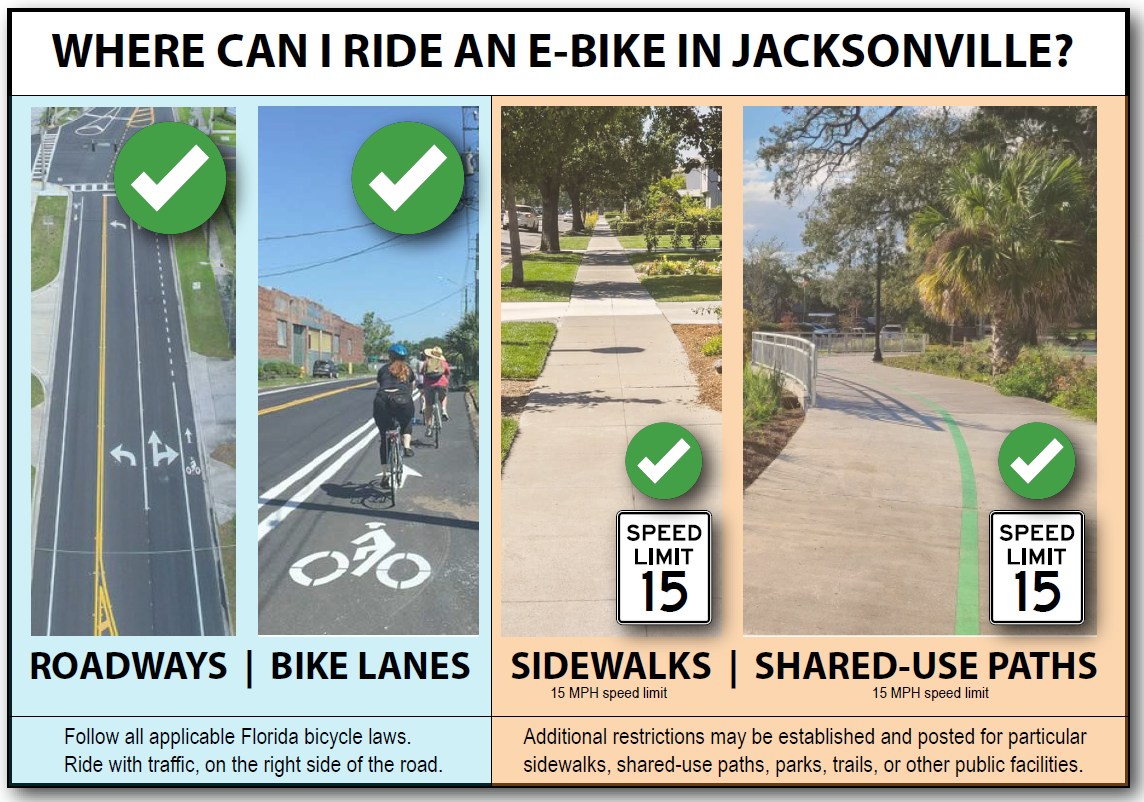
When Riding on Sidewalks and Shared-Use Paths
- 15-mph Speed Limit: You may not exceed 15 mph on sidewalks or shared-use paths.
- Audible Warning and Safe Passing: When passing pedestrians or slower-moving cyclists, give an audible warning (such as ringing a bell or using your voice) and pass at a safe distance.
- Yield to Pedestrians: E-bike riders must yield the right-of-way to pedestrians on sidewalks and shared-use paths.
- Pedestrian Signs and Signals: Obey applicable pedestrian traffic signs and signals.
- Unsafe Operation: Even when following the posted speed limit, riders may violate the law if they operate an e-bike in an unsafe manner or at a speed that is unreasonable for existing conditions.
What Is Considered Unsafe E-Bike Operation?
Ordinance 2026-0570-E identifies several examples of unsafe operation, including:
- Unsafe passing
- Failure to yield
- Weaving or unpredictable operation
- Stunts or other operation that reduces the rider’s control
- Traveling at a speed that is unreasonable for existing conditions
- Creating an unreasonable hazard to pedestrians or other users
- Failing to comply with posted restrictions
- Leaving the roadway to avoid a traffic-control device, such as a stoplight or stop sign
Equipment, Passengers, and Modifications
Helmets: Riders and passengers under 16 must wear a properly fitted, securely fastened bicycle helmet.
Passengers: Passengers are permitted only if the e-bike has a designated passenger seat and meets all applicable safety standards.
E-bike Lighting and Visibility
- When riding between sunset and sunrise, your e-bike must have:
- A white front light visible from at least 500 feet
- A red rear light and red rear reflector, each visible from 600 feet
- All safety lights must be on and working during these hours
E-bike Modifications: Modifying an e-bike’s motor to allow speeds above its manufacturer-designed maximum is prohibited in Jacksonville.
Know Before You Buy
Buying an e-bike? Before purchasing, check the e-bike’s class, maximum motor-assisted speed, battery and charger information, and manufacturer labeling. Understanding your e-bike’s classification will help you know which laws and operating requirements apply.
Florida E-Bike Laws
Florida law gives an e-bike and its operator the same rights, privileges, and duties as a bicycle and bicycle operator. Florida also allows local governments to regulate e-bike operation on streets and sidewalks under their jurisdiction and allows agencies with jurisdiction over bicycle paths, shared-use paths, and trail networks to restrict or prohibit e-bike operation there.
Understanding E-Bike Classifications
Legal e-bikes in Florida are separated into three classes: Class 1, Class 2, and Class 3. These classifications describe how the motor provides assistance and the speed at which motor assistance stops. E-bikes of different classes can look very similar. Make sure you know your e-bike’s class before purchasing by checking the manufacturer’s label or asking your dealer.
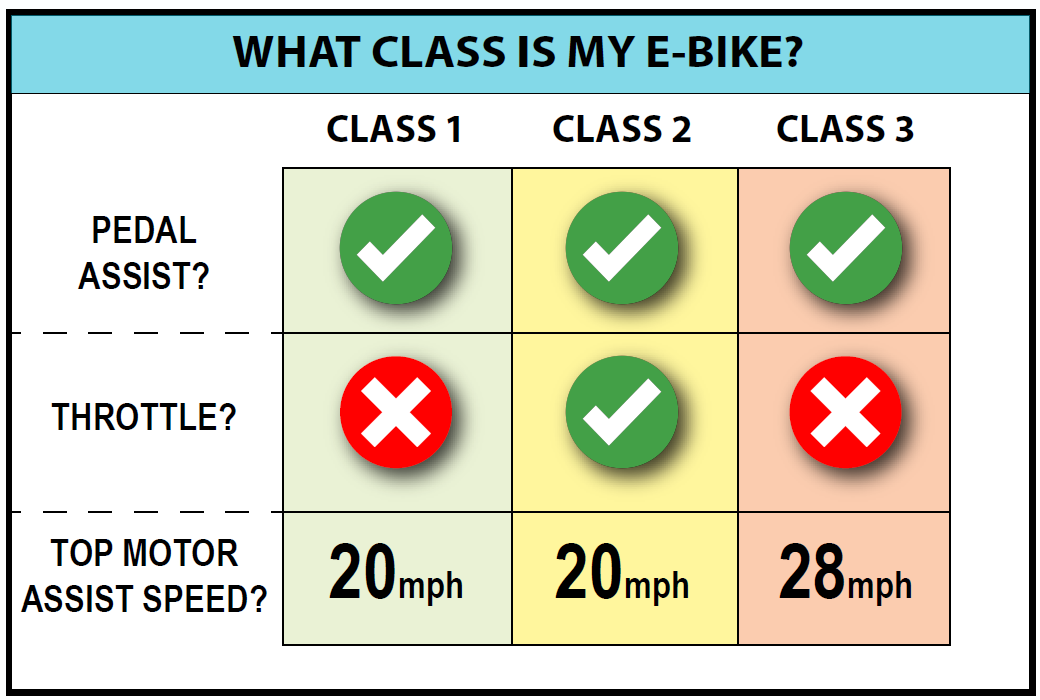
Florida Law States That:
- E-bikes may generally be ridden where bicycles are permitted, including streets, roadways, shoulders, bicycle lanes, and bicycle or shared-use paths.
- Manufacturers and distributors must permanently label an e-bike with its classification, top assisted speed, and motor wattage.
- E-bikes must comply with applicable federal bicycle equipment/manufacturing requirements.
Florida Statutes § 316.20655 — Electric Bicycle Regulations
Safety Recommendations
In addition to following applicable laws, e-bike riders are encouraged to practice safe and responsible riding habits.
- Slow down around pedestrians and in congested areas.
- Use lights and make yourself visible.
- Ride predictably.
- Avoid distractions.
- Allow adequate stopping distance.
- Use extra caution at driveways and intersections.
- Inspect brakes and tires regularly. Remember the bicycle ABCs: Air, Brakes, Chain.
- Understand how the additional weight and acceleration of an e-bike affects handling.
E-Bike Battery Safety
Most e-bikes use rechargeable lithium-ion batteries. As with other devices powered by lithium-ion batteries, proper charging, storage, and handling are important to reduce the risk of overheating or fire. Riders should follow the e-bike and battery manufacturer’s instructions and use batteries, chargers, and replacement equipment that are designed and approved for their specific e-bike.
E-Bike Battery and Charging Safety Tips
- Use the correct charger: Use only the charger supplied with your e-bike or a replacement charger that has been tested and approved for use with your specific e-bike and battery. The U.S. Consumer Product Safety Commission (CPSC) warns against using chargers marketed as “universal,” which may physically connect to an e-bike but still be incompatible with its battery.
- Never leave batteries charging unattended: Always be present while charging your e-bike battery. Do not charge an e-bike or battery while sleeping or when no one is home.
- Follow charging instructions: Follow the manufacturer’s charging instructions and unplug the charger when charging is complete.
- Use approved replacement batteries: Use only replacement batteries approved for your e-bike. Avoid battery packs that have been modified, reworked, or assembled using repurposed or used battery cells.
- Dispose of batteries properly: Do not place lithium-ion batteries in household trash or general recycling. Follow local requirements for proper battery recycling or disposal.
- Look for appropriate safety certifications: When purchasing an e-bike, look for products designed, manufactured, and certified to applicable safety standards.
Learn More About E-Bike Battery Safety
- League of American Bicyclists and PeopleForBikes: E-Bike Battery Safety: https://www.ebikesmart.org/ebike-battery-safety
- PeopleForBikes: What You Should Know About E-Bike Battery Certification:https://www.peopleforbikes.org/news/what-you-should-know-about-e-bike-battery-certification
- Grey Beard E-Biking: E-Bike Battery Safety Tips:https://www.youtube.com/watch?v=jyNSzj0TVHw
- U.S. Consumer Product Safety Commission: Micromobility Battery and Charging Safety:https://www.cpsc.gov/Safety-Education/Safety-Education-Centers/Micromobility-Information-Center
- CPSC: Warning About Universal E-Bike and Micromobility Chargers:https://www.cpsc.gov/Newsroom/News-Releases/2024/CPSC-Urges-Consumers-to-Not-Buy-or-Use-Universal-Chargers-with-Micromobility-Products-Due-to-Fire-Hazard
E-Bike Safety Resources
The following organizations and resources provide additional information about e-bike regulations, bicycle safety, education, and active transportation.
Learn to Ride Safely - Training Lessons and Safety Guidance
- League of American Bicyclists E-Bike Training Lessons: https://learn.bikeleague.org/products/e-bike-smart
- PeopleForBikes' E-Bike Smart Campaign: https://www.ebikesmart.org/
- Community Traffic Safety Team E-Bike Safety Clearing House: https://trafficsafetyteam.org/e-bike-safety/
- National Highway Traffic Safety Administration (NHTSA): https://www.nhtsa.gov/road-safety/bicycle-safety
Rules and Regulations
- City of Jacksonville — Ordinance 2026-0570-E: https://jaxcityc.legistar.com/LegislationDetail.aspx?ID=8144675&GUID=F68F3489-B3BC-4928-9623-EBEDF858D392
- Florida Statutes — Electric Bicycle Regulations: https://www.leg.state.fl.us/Statutes/index.cfm?App_mode=Display_Statute&URL=0300-0399/0316/Sections/0316.20655.html
Duval County Public Schools
- Duval County Public Schools — Be Safe, Be Seen: https://www.duvalschools.org/page/be-safe-be-seen/
City of Jacksonville Bicycle and Pedestrian Resources
- City of Jacksonville Pedestrian and Bicycle Planning: https://www.jacksonville.gov/departments/planning-department/transportation-planning/ped-bike-planning
- City of Jacksonville Vision Zero Action Plan: https://www.jacksonville.gov/departments/planning-department/transportation-planning/ped-bike-planning/vision-zero-action-plan-(vzap)
- Jacksonville Bicycle and Pedestrian Trails and Maps: https://coj-planning.maps.arcgis.com/apps/webappviewer/index.html?id=693bf590abdd451e9968b13fa3b1952b
Florida Department of Transportation (FDOT)
- E-Bike Safety: https://www.fdot.gov/d5safety/office-of-safety-resources/e-bike-safety
- Bicycle and Pedestrian Information: https://www.fdot.gov/Safety/programs/pedestrian-and-bicycle-safety
- Target Zero Initiative: https://www.fdot.gov/safety/target-zero/
- Safe Routes to School — Florida Department of Transportation: https://www.fdot.gov/Safety/programs/safe-routes.shtm
For E-Bike Retailers: Printable Safety Signage (To Be Displayed Where E-Bikes Are Sold)
Jacksonville Ordinance 2026-0570-E includes educational signage requirements for businesses selling electric bicycles in Duval County. To help retailers share this information with customers, the City of Jacksonville has developed a standardized e-bike safety sign highlighting important local regulations and providing a QR code linking to additional safety information. Under Section 804.903, retailers must make a reasonable effort to display or provide customers with the City's e-bike safety information, including the QR code or website address. Retailers are encouraged to download, print, and prominently display the sign at or near locations where electric bicycles are offered for sale.
Download the E-Bike Retailer Safety Sign (8.5" × 11" PDF)
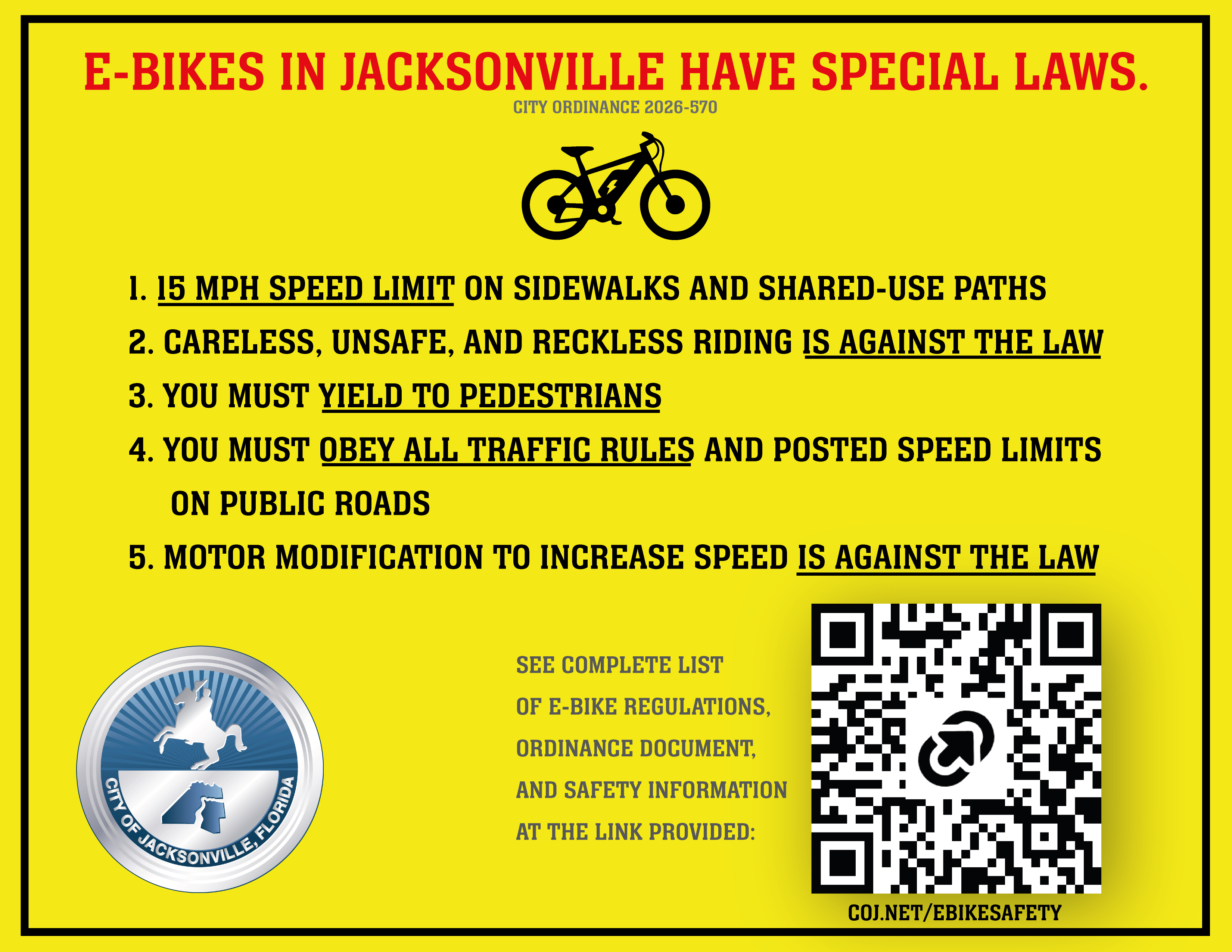
The sign is provided free of charge and is formatted for printing on standard letter-size paper. For additional information, see Section 804.903 of Ordinance 2026-0570-E.
Have More Questions about E-Bikes?
- City of Jacksonville Transportation Planning Division
- Email: JPDTransportation@coj.net
- Phone: (904) 255-7800