Vision Zero Action Plan (VZAP)
The City of Jacksonville is taking a proactive approach to improve safety for all road users. The Vision Zero Action Plan (VZAP) outlines a data-driven strategy to eliminate traffic fatalities and reduce serious injuries by 50 percent by 2035.
Final Vision Zero Action Plan as a downloadable PDF file (PLAN)
Final Vision Zero Action Plan as a downloadable PDF file (APPENDICES)
What the Vision Zero Action Plan Includes
The Vision Zero Action Plan (VZAP) is now being actively implemented across Jacksonville. Key components include:
- High Injury Network (HIN): Identifies corridors and intersections with the highest number of serious injuries and fatalities to prioritize safety improvements.
- Data-Driven Safety Improvements: Focuses on proven strategies such as safer crossings, bicycle facilities, and speed management to reduce risk on the most dangerous roadways.
- Performance Tracking and Transparency: Progress is monitored through publicly available dashboards (links below), allowing the City and community to track implementation and outcomes over time.
- Crash Data Analysis: Uses detailed crash data to better understand where and why severe crashes occur and to guide targeted interventions.
- Community Engagement: Builds awareness and encourages community involvement to support a culture of safety across Jacksonville.
- Demonstration and Quick-Build Projects: Tests and implements safety improvements in priority areas to accelerate progress and inform future investments.
- Partnerships and Coordination: Works in collaboration with partner agencies, including the Florida Department of Transportation (FDOT), Jacksonville Transportation Authority (JTA), the North Florida Transportation Planning Organization (TPO), and local law enforcement.
Working Toward Zero
Through ongoing implementation of the VZAP, Jacksonville is advancing a safer transportation system for all users. By prioritizing the most dangerous locations and applying data-driven solutions, the City is working to reduce serious injuries and fatalities and create safer streets for everyone.
Vision Zero Data Dashboards for Monitoring Performance
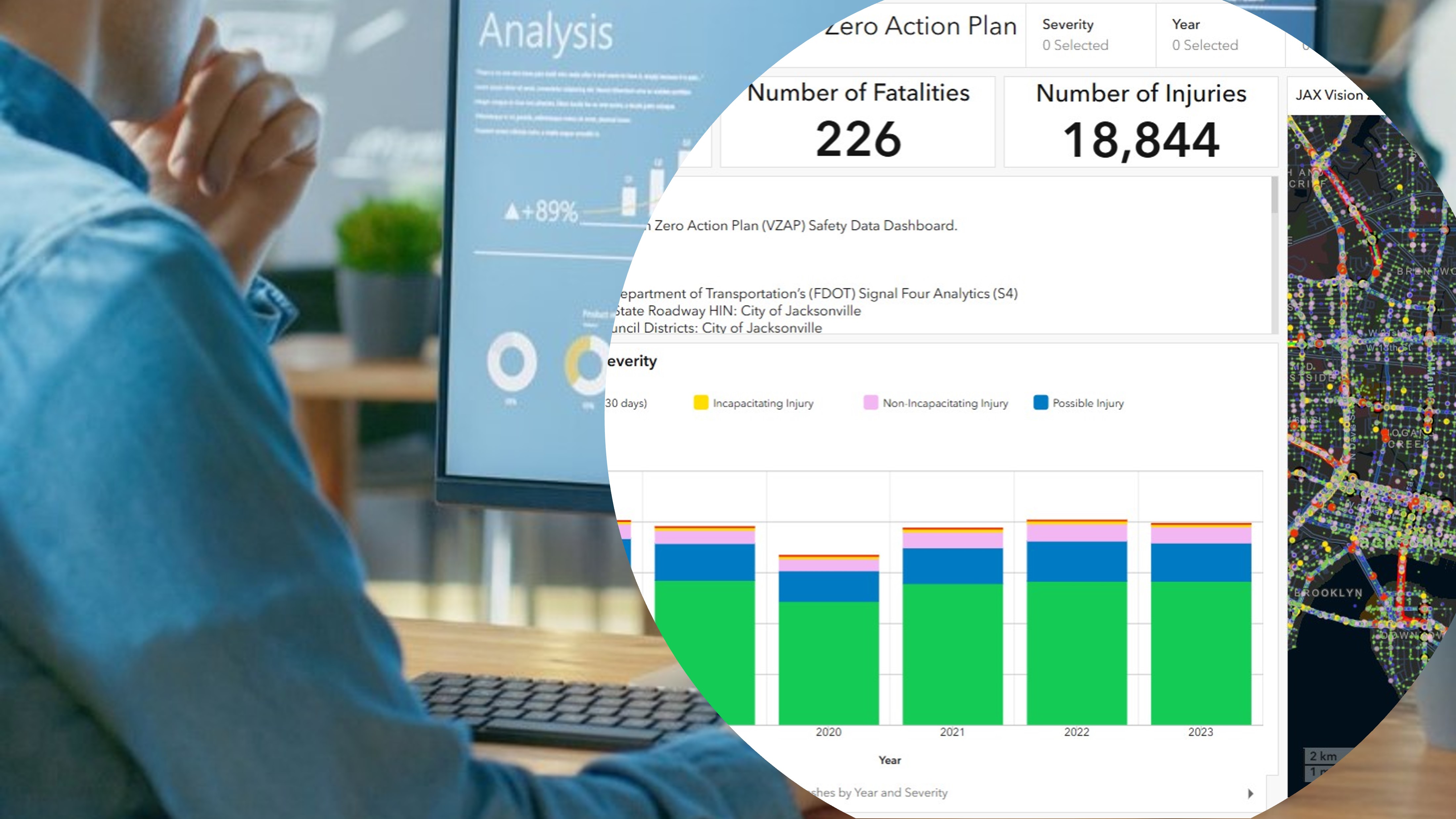
Two public-facing data dashboards have been developed through the Vision Zero Action Plan to promote transparency and accountability, allowing residents to monitor Jacksonville’s progress towards eliminating all traffic related fatalities citywide.
Visit the Safety Data Dashboard (LINK)
Highlights trends in traffic related crashes, serious injuries, and fatalities, helping to inform data-driven decision-making
Visit the Demonstration & Capital Projects Dashboard (LINK)
Showcases ongoing and planned safety improvements, as identified in the Plan.
High Injury Networks Created for Local Roads and State Roadways by Mode (HINs)
The most severe crashes are concentrated along certain corridors and intersections. To focus safety efforts where they are needed most, fatal and serious injury crashes across pedestrian, bicycle, motorcycle, and vehicle modes were mapped and analyzed. High injury corridors and intersections were identified and combined to create a High Injury Network which will guide the strategies in the VZAP.Visit the Local High Injury Network Map (LINK)
Visit the State High Injury Network Map (LINK)
Click here to download PDF versions of the High Injury Networks
VISION ZERO ACTION PLAN – TEXT VERSION (FULL, ADA-FRIENDLY)
CITY OF JACKSONVILLE
VISION ZERO ACTION PLAN
FINAL – JULY 2025
PHOTO SOURCES: CITY OF JACKSONVILLE
A MESSAGE FROM THE MAYOR
Dear Friends,
It’s with great pride that the City of Jacksonville is introducing this Vision Zero Action Plan—a bold and necessary step toward a safer, more connected future for every resident who travels our roadways. This action plan is not merely a policy document—it is a life-saving commitment, aligning with our administration’s core priorities of infrastructure, public safety, and health.
Our goal to eliminate all traffic fatalities and reduce serious injuries by 50% by 2035 is a reflection of our values and our belief that every resident deserves to move safely through this City, regardless of how they travel.
Jacksonville is ranked among the most dangerous U.S. cities for pedestrians. Between 2018 and 2023, there were nearly 200,000 crashes, with 921 fatalities and 2,770 serious injuries. Vulnerable road users like bicyclists, pedestrians, and motorcyclists continue to face disproportionate risk. These are not just statistics—they are our neighbors, friends, and loved ones. We must act with urgency and resolve.
The Vision Zero Action Plan prioritizes safety and smart investments. Guided by a Safe System Approach, the plan reflects the input of over 50 task force members, 80 recommended strategies, and extensive community engagement. It identifies a High Injury Network—the corridors and intersections where the most severe crashes occur—and recommends capital investments and projects in those areas for maximum impact.
These investments are designed to reduce crashes through infrastructure upgrades, better lighting, safer street designs, and multimodal enhancements.
I am grateful for the dedication of the City’s transportation professionals, community stakeholders, and national partners who have contributed to this plan. Let this be the decade of transformation for our City. Let’s move forward—safely and boldly.
Sincerely,
Donna Deegan
Mayor, City of Jacksonville
TEXT-ONLY VERSION – TABLE OF CONTENTS
A Message from the Mayor
In Memoriam
Vision Zero Goal
Implementation & Accountability
1. Vision Zero
1.1 Executive Summary
1.2 What is Vision Zero
1.3 Getting to Zero
2. Jacksonville Today
2.1 Citywide Crash Trends
2.2 Existing Plans
2.3 Prior & Ongoing Safety Efforts
2.4 Collaboration with JTA
3. Voices of Jacksonville
3.1 Developing the Action Plan
3.2 Vision Zero Task Force & Stakeholder Group
3.3 Community Engagement & Outreach
3.4 World Day of Remembrance
3.5 Stories
4. High Injury Network
5. Action Plan Strategies
5.1 Safe System Approach
5.2 Themes & Safety Problems
5.3 Strategies and Actions
5.4 Measuring Progress
6. Vision Zero Projects
6.1 Capital Projects
6.2 Demonstration Projects
7. Acknowledgments
8. Appendices
Appendix A – Local Road HIN
Appendix B – State Road HIN
Appendix C – Safety Problems Long-List
Appendix D – Strategies and Actions
Appendix E – Capital Projects
Appendix F – Demonstration Projects
IN MEMORIAM
EVEN ONE IS TOO MANY.
Every traffic-related death is a tragic loss—one that cuts a life short, devastates loved ones, and impacts the entire community. Countless others have survived severe traffic injuries, often facing life-altering consequences.
This Action Plan is dedicated to those who have lost their lives while traveling on City of Jacksonville streets.
VISION ZERO GOAL
THE VISION ZERO ACTION PLAN IS THE FIRST STEP TOWARDS ELIMINATING ALL TRAFFIC FATALITIES AND REDUCING SERIOUS INJURIES BY 50% BY 2035
GOAL:
Eliminate all traffic fatalities
Reduce serious injuries by 50%
Target year: 2035
IMPLEMENTATION & ACCOUNTABILITY
This Vision Zero Action Plan represents the beginning of an ongoing commitment. The City will move forward with implementation, monitoring, and accountability to ensure measurable progress toward safer streets.
1. VISION ZERO
1.1 ACTION PLAN EXECUTIVE SUMMARY
Nationally, more than 42,000 people are killed in traffic crashes every year, and thousands more are injured. These are not just statistics—they represent lives lost and families forever changed.
In Jacksonville alone, there were approximately 145 crash-related deaths in 2024.
The City of Jacksonville experiences a disproportionate impact of fatal and serious injury traffic crashes on vulnerable road users:
Bicyclists: 80% higher injury rate
Pedestrians: 77% higher injury rate
Motorcyclists: 77% higher injury rate
Vehicle occupants: 26%
These disparities underscore the urgent need to prioritize those most at risk.
HIGH INJURY NETWORK OVERVIEW
The most severe crashes are concentrated along specific corridors and intersections. To address this, the City mapped and analyzed fatal and serious injury crashes across all modes:
Pedestrian
Bicycle
Motorcycle
Vehicle
These were combined to create a High Injury Network (HIN) that will guide all strategies in the Vision Zero Action Plan.
DEMONSTRATION PROJECTS
An important step toward implementation is advancing demonstration (quick-build) projects along the HIN.
These projects:
Can be delivered quickly
Are cost-effective
Provide real-world testing of safety improvements
An initial set of 25 demonstration projects has been identified.
CAPITAL PROJECTS
A key component of the VZAP is strategic investment in capital projects aligned with the HIN.
These projects focus on:
Roadway redesign
Speed management
Multimodal safety improvements
ACTION PLAN STRATEGIES
Themes organize safety challenges and strategies into focused areas of action. A long list of safety problems was developed and refined through stakeholder input, resulting in a recommended strategy list.
DATA SOURCES
U.S. Department of Transportation – National Roadway Safety Strategy
FDOT Signal Four Analytics
1.2 WHAT IS VISION ZERO
Vision Zero originated in Sweden in the 1990s based on the principle that traffic deaths are preventable.
It focuses on designing roadway systems that:
Anticipate human error
Reduce crash severity
Protect all users
Jacksonville aligns with:
FDOT Target Zero
National roadway safety initiatives
1.3 GETTING TO ZERO
Jacksonville will implement the Safe System Approach, focusing on:
Safer People
Safer Roads
Safer Vehicles
Safer Speeds
Better Post-Crash Care
The 4 E’s:
Engineering
Education
Enforcement
Emergency Response
These work together to create a proactive, comprehensive safety system.
2. JACKSONVILLE TODAY
Motor vehicle fatalities remain one of the leading causes of death in the United States. The National Highway Traffic Safety Administration (NHTSA) estimates that 40,990 people died in traffic crashes in the United States in 2023. These incidents have a lasting impact not only on the victims and their families but also on the surrounding community.
The Florida Department of Transportation (FDOT) estimates that the total cost to society for each crash is approximately $10.9 million. These impacts underscore the urgency of improving roadway safety across Jacksonville.
2.1 CITYWIDE CRASH TRENDS
Fatal and serious injury crashes have affected Jacksonville for years. To effectively address these safety issues, it is critical to understand where and why crashes are occurring.
The City analyzed five years of crash data from 2018 to 2023:
Total crashes: 196,453
Fatal and serious injury crashes: 3,691
Fatalities: 921
Serious injuries: 2,770
Most concerning, 34% of fatal and serious injury crashes involved vulnerable road users, including pedestrians, bicyclists, and motorcyclists.
THE DANGERS OF WALKING OR RIDING A BICYCLE
Although fewer people choose to walk or bike compared to driving, those who do face disproportionately high risks.
Pedestrian safety is a significant concern nationwide, with more than 20 pedestrians killed on average every day in the United States. However, individuals who walk in Jacksonville face even greater risks.
In 2022, Jacksonville ranked as the 6th most dangerous metropolitan area for pedestrians according to Smart Growth America’s Dangerous by Design report.
By 2024, the City improved to 15th most dangerous, reflecting progress but still highlighting ongoing risk.
Between 2018 and 2023:
441 fatal and serious injury crashes involved pedestrians
211 pedestrian fatalities occurred
Each of these represents a life lost and a family forever changed.
Bicyclist safety is also a major concern:
148 fatal and serious injury crashes involved bicyclists
Jacksonville remains one of the more dangerous cities in the United States for cyclists.
UNDERSTANDING CRASH FACTORS – PEDESTRIANS & BICYCLISTS
Crash data reveals several recurring contributing factors:
Intersection design challenges
44% of fatal and serious injury bicycle crashes occurred at intersections
Poor lighting and nighttime visibility
60% of pedestrian fatal and serious injury crashes occurred at night
Infrastructure gaps
Missing sidewalks
Limited bicycle facilities
Inconsistent crossing treatments
These findings highlight the need for a comprehensive, system-wide approach to improving safety for vulnerable road users.
UNDERSTANDING CRASH FACTORS – VEHICLES & MOTORCYCLES
Additional key contributing factors were identified for vehicle and motorcycle crashes:
Lack of occupant protection
24% of fatal and serious injury vehicle crashes involved individuals not using seat belts or proper restraints
High speeds and aggressive driving
20% of fatal and serious injury motorcycle crashes involved speeding or aggressive driving
Impaired driving
54% of fatal vehicle crashes involved drugs or alcohol
62% of fatal motorcycle crashes involved impairment
These factors significantly increase crash severity and highlight the importance of speed management, enforcement, and education.
CRASH DISTRIBUTION (SUMMARY)
Fatal and serious injury crash totals (2018–2023):
Pedestrian: 441
Bicycle: 148
Vehicle: 1,568
Motorcycle: 409
Crash density analysis shows that severe crashes are concentrated in specific areas of the City, reinforcing the importance of targeted interventions.
2.2 EXISTING PLANS
The Vision Zero Action Plan builds upon and aligns with several existing planning efforts and programs already underway in Jacksonville.
Pedestrian and Bicycle Master Plan (2017)
Developed to create a prioritized network of bicycle and pedestrian facilities, this plan focuses on expanding safe, comfortable, and connected routes for users of all ages and abilities.
Capital Improvement Program (CIP)
The CIP identifies and funds infrastructure projects across the City, including transportation improvements. It serves as a key mechanism for implementing safety-focused capital investments.
North Florida Transportation Planning Organization (TPO)
The City partners with the North Florida TPO on regional transportation planning efforts, including:
Transportation Improvement Program (TIP)
A five-year program of transportation projects
Includes roadway, transit, aviation, seaport, bicycle, and pedestrian projects
Long-Range Transportation Plan (2045)
Congestion management planning
Public engagement and project prioritization
Corridor and Traffic Studies
The City has completed numerous corridor and traffic studies to identify safety and mobility improvements, including:
Moncrief Road Corridor Study (2024)
Sunbeam Road Corridor Study (2024)
Rogero Road Corridor Study (2023)
Myrtle Avenue Corridor Study (2022)
8th Street Corridor Study (2022)
Hodges Boulevard Traffic Study (2021)
Parental Home Road Corridor Study (2021)
Chaffee Road Corridor Study (2020)
Monument Road Traffic Study (2020)
These studies provide detailed recommendations that support Vision Zero implementation.
2.3 PRIOR & ONGOING SAFETY EFFORTS
Jacksonville has undertaken a wide range of initiatives to improve roadway safety through innovation, partnerships, and community engagement.
20 is Plenty Program
Speeding and aggressive driving were identified as primary contributors to crashes on residential streets.
The 20 is Plenty initiative:
Reduces residential speed limits from 30 mph to 20 mph
Improves safety for pedestrians and bicyclists
Aligns with Vision Zero principles
Uses data and community feedback to guide implementation
Smart Surfaces Initiative
This program focuses on:
Improving roadway traction
Enhancing visibility
Using innovative materials
Particularly in high-crash locations, Smart Surfaces help reduce crash risk and severity.
Better Jacksonville Plan
A $2.25 billion comprehensive program that includes:
Roadway and infrastructure improvements
Environmental preservation
Economic development
Public facility enhancements
This program supports broader safety and mobility goals.
Targeted Community Focus
Efforts prioritize high-risk corridors and communities, including:
Blue Zones neighborhoods
Areas with elevated crash rates
Key Lessons Learned
Data-driven approaches are critical
Public engagement improves outcomes
Partnerships accelerate implementation
Challenges include:
Funding limitations
Enforcement consistency
Resistance to change
Despite these challenges, continued collaboration has helped advance safety goals.
2.4 COLLABORATION WITH JACKSONVILLE TRANSPORTATION AUTHORITY (JTA)
The City of Jacksonville works closely with the Jacksonville Transportation Authority (JTA) and other regional partners to advance roadway safety.
Creating Safe Spaces Action Plan (CSSAP)
JTA’s safety plan focuses on:
Data-driven analysis
Community engagement
Strategic implementation
Key principles:
Safety is embedded at all levels of the organization
Crash data informs decision-making
Stakeholder collaboration is essential
FDOT Target Zero Initiative
Jacksonville collaborates with FDOT to:
Eliminate traffic fatalities statewide
Integrate engineering, enforcement, and education strategies
Regional Partnerships
The City also works with:
North Florida TPO
Community organizations
Advocacy groups
These partnerships support initiatives such as:
Pedestrian safety campaigns
Data sharing
Coordinated planning
Ongoing Collaboration
The City of Jacksonville and JTA worked closely together in developing their respective action plans and will continue to collaborate in implementing strategies to achieve Vision Zero goals.
3. VOICES OF JACKSONVILLE
3.1 DEVELOPING THE ACTION PLAN
The City of Jacksonville’s Vision Zero Action Plan (VZAP) was developed through a structured, collaborative, and data-driven process.
The effort began in February 2023 when the City secured approximately $350,000 in funding, including federal support matched with local contributions. This funding enabled a comprehensive planning effort focused on improving roadway safety across Jacksonville.
Throughout development, the City prioritized:
Interagency coordination
Community engagement
Data-driven decision-making
Stakeholders included:
City departments
Regional and state agencies
Community organizations
Residents
Transportation professionals
These stakeholders participated in:
Task force meetings
Public workshops
Surveys
Ongoing coordination efforts
KEY MILESTONES
The development of the VZAP followed a clear timeline:
February 2023
Project initiation and funding securedAugust 2024
Completion of:Comprehensive crash analysis
High Injury Network (HIN) identification
September 2024
Award of approximately $1.27 million in federal funding for safety demonstration projectsFebruary 2025
Selection of:Demonstration projects
Initial implementation priorities
March 2025
Development of:Performance measures
Tracking framework
Summer 2025
Finalization and adoption of the Vision Zero Action Plan
This process ensured that the plan is grounded in both data and community input, while aligning with regional safety initiatives such as the Jacksonville Transportation Authority’s Creating Safe Spaces Action Plan (CSSAP).
3.2 VISION ZERO TASK FORCE & STAKEHOLDER GROUP
A multidisciplinary Vision Zero Task Force and Stakeholder Group was established to guide the development of the VZAP.
Composition
The group included over 50 members representing:
City of Jacksonville departments
Regional agencies
State partners (including FDOT)
Jacksonville Transportation Authority (JTA)
Advocacy organizations
Community stakeholders
Role of the Task Force
The Task Force played a critical role in shaping the plan by:
Reviewing crash data and safety trends
Identifying key safety issues
Prioritizing themes and strategies
Providing feedback on proposed actions
The group met multiple times throughout the planning process to:
Discuss findings
Share expertise
Generate ideas
Refine recommendations
Outcome
The collaborative nature of the Task Force ensured that:
The plan reflects diverse perspectives
Strategies are practical and implementable
Community needs are integrated into decision-making
3.3 COMMUNITY ENGAGEMENT & OUTREACH
Public engagement was a central component of the VZAP development process.
The City actively engaged residents to:
Understand real-world safety challenges
Gather input on priorities
Build support for Vision Zero initiatives
Community feedback consistently emphasized a strong desire for safer streets and a willingness to support policy changes that reduce roadway deaths and serious injuries.
ENGAGEMENT METHODS
1. Vision Zero Website
The City developed a Vision Zero website to:
Provide background information
Share data and analysis
Host surveys
Offer updates on plan development
The website also includes:
A public-facing dashboard
Ongoing crash data monitoring
Implementation tracking tools
2. Online Surveys
Two online surveys were conducted.
First Survey (October 2024 – January 2025)
Collected 16 responses
Identified key safety concerns
Top priorities included:
Safer roadway design
Pedestrian and bicyclist safety
School zone improvements
Common concerns:
Speeding vehicles
Poor street lighting
Dangerous intersections
Second Survey (February 2025 – May 2025)
Collected 14 responses
Focused on proposed strategies and projects
Top priorities included:
Safer street design
Sidewalk connectivity
Safer intersections
Respondents emphasized the importance of:
Demonstration projects
Capital investments
Visible safety improvements
3. Public Workshops
Two public workshops were held to:
Share plan updates
Present findings
Gather community input
These workshops provided a platform for residents to:
Share personal experiences
Identify safety concerns
Provide feedback on proposed strategies
The input received directly influenced:
Strategy development
Project selection
Overall plan direction
COMMUNITY PERSPECTIVE SUMMARY
Public engagement revealed that residents:
Strongly support Vision Zero goals
See themselves as advocates for safer streets
Prioritize pedestrian and bicyclist safety
Want improvements in school zones
Identify lighting, speeding, and intersections as key issues
This feedback reinforced the need for collective action and community partnership in achieving Vision Zero.
3.4 WORLD DAY OF REMEMBRANCE
The City of Jacksonville participates annually in the World Day of Remembrance for Road Traffic Victims, held on the third Sunday of November.
This global event provides an opportunity to:
Honor victims of traffic crashes
Support grieving families
Raise awareness about roadway safety
COMMUNITY IMPACT
The event brings together:
Survivors
Families of victims
Community members
Safety advocates
Participants share personal stories that:
Humanize crash data
Highlight the real impact of traffic violence
Strengthen the City’s commitment to safety
2024 EVENT
At the 2024 event:
508 white flags were displayed
Representing lives lost over the past three years
Mayor Donna Deegan reaffirmed the City’s commitment, stating:
“The loss of your loved ones is made even more tragic by the fact that most roadway injuries and deaths are preventable. Roadway safety requires us to be proactive.”
The event also marked a major milestone:
Announcement of Jacksonville’s first Vision Zero Action Plan
3.5 STORIES
Personal stories underscore the human impact of traffic crashes and reinforce the urgency of Vision Zero efforts.
ALLISON HARAMIS
Allison Haramis was killed in a car crash in 2009 at the age of 15 while on her way home from school.
Her father, Drew Haramis, remembers her as:
Fun
Loving
Hard-working
Passionate about dancing
He describes her as having:
The best laugh
A beautiful smile
In her honor, Drew founded Angels for Allison, an organization dedicated to keeping her memory alive and advocating for safety.
ALONDRA MARTINEZ
Alondra Martinez was killed in January 2024 at the age of 16 after being struck by a car near her bus stop.
The crash occurred near:
Old Kings Road
Habana Avenue
Residents had long expressed concerns about safety at this intersection.
Alondra was:
A dedicated student
Attended Atlantic Coast High School
Remembered for her impact on those around her
Her family continues to advocate for safety improvements to prevent similar tragedies.
PURPOSE OF STORIES
These stories:
Put faces to statistics
Highlight preventable loss
Reinforce the urgency of action
They serve as a reminder that:
Every crash represents a life, a family, and a community impacted.
4. HIGH INJURY NETWORK
The most severe crashes in Jacksonville are not evenly distributed across the roadway system. Instead, they are concentrated along specific corridors and at particular intersections. To effectively reduce fatalities and serious injuries, it is critical to focus safety efforts where they are needed most.
To support this effort, the City conducted a comprehensive analysis of fatal and serious injury crashes across all travel modes:
Pedestrians
Bicyclists
Motorcyclists
Motor vehicle occupants
Using this data, high-crash corridors and intersections were identified and combined to create the High Injury Network (HIN).
PURPOSE OF THE HIGH INJURY NETWORK
The High Injury Network serves as the foundation for the Vision Zero Action Plan by:
Identifying where the most severe crashes occur
Prioritizing safety investments in those locations
Guiding project selection and implementation
Supporting data-driven decision-making
By focusing on the HIN, Jacksonville can maximize the impact of safety improvements and efficiently allocate resources to areas with the greatest need.
HIN DEVELOPMENT
The HIN was developed by mapping and analyzing crash data from 2018 to 2023, focusing specifically on fatal and serious injury crashes.
The analysis included:
Crash locations
Crash severity
Contributing factors
Mode-specific patterns
This approach ensures that the HIN reflects real-world conditions and accurately identifies high-risk areas.
NETWORK STRUCTURE
To better understand and address safety issues, the HIN is divided into multiple categories based on roadway type and crash characteristics.
SEGMENT-BASED HIN
Roadway segments were categorized into:
State Roads (excluding limited access facilities)
Local Roads
Segment-based analysis identifies corridors where crashes are concentrated along a stretch of roadway.
INTERSECTION-BASED HIN
Intersections were categorized into:
State roads intersecting with state roads
State roads intersecting with local roads
Local roads intersecting with local roads
Intersection-based analysis identifies locations where conflicts between users are most likely to occur.
MODE-SPECIFIC HIN
The HIN was further refined by mode to better target safety improvements:
Pedestrian High Injury Network
Bicycle High Injury Network
Vehicle High Injury Network
Motorcycle High Injury Network
Each mode-specific HIN highlights unique risk patterns and informs tailored safety strategies.
LOCAL AND STATE HIN
The HIN is separated into two primary systems:
Local Road High Injury Network
Managed by the City of Jacksonville
Focus of local safety investments
Detailed in Appendix A
State Road High Injury Network
Managed by the Florida Department of Transportation (FDOT)
Requires coordination with state partners
Detailed in Appendix B
HIN MAPPING AND DATA
The Vision Zero Action Plan includes detailed maps illustrating:
High-risk corridors
High-risk intersections
Mode-specific crash concentrations
These maps visually demonstrate that:
A relatively small portion of the roadway network accounts for a large share of fatal and serious injury crashes
Certain corridors consistently appear across multiple modes
KEY TAKEAWAYS
The High Injury Network analysis reveals several important insights:
Severe crashes are concentrated in specific geographic areas
Many high-risk locations serve multiple travel modes
Intersections are particularly critical locations for safety improvements
State and local coordination is essential for addressing the full network
ROLE OF THE HIN IN IMPLEMENTATION
The High Injury Network is not just an analytical tool—it is central to implementation.
The City will use the HIN to:
Prioritize capital projects
Select demonstration projects
Guide funding decisions
Coordinate with FDOT and regional partners
Track progress over time
All major Vision Zero investments will be aligned with the HIN to ensure maximum safety impact.
CONNECTION TO APPENDICES
Additional details on the High Injury Network can be found in:
Appendix A – Local Road High Injury Network
Appendix B – State Road High Injury Network
These appendices include:
Detailed roadway listings
Segment extents
Planning districts
Council districts
Mode-specific HIN classifications
SUMMARY
The High Injury Network provides a clear, data-driven framework for identifying where safety improvements are most needed.
By focusing on these high-risk locations, Jacksonville can:
Reduce fatalities and serious injuries more effectively
Improve safety for all road users
Advance the Vision Zero goal of eliminating traffic deaths
5. ACTION PLAN STRATEGIES
5.1 A SAFE SYSTEM APPROACH
The Safe System Approach is the foundation for Jacksonville’s Vision Zero Action Plan. This framework recognizes that while human error is inevitable, traffic fatalities and serious injuries are preventable through thoughtful system design.
The Safe System Approach focuses on:
Anticipating human mistakes
Reducing the likelihood of crashes
Minimizing the severity of crashes when they occur
The goal is to create a transportation system that is:
Forgiving
Redundant
Safe for all users
CORE PRINCIPLES
Jacksonville’s approach is guided by the following principles:
Human life and health are prioritized above all else
Humans make mistakes, and the system should accommodate those mistakes
Human bodies have limited tolerance to crash forces
Responsibility for safety is shared among all stakeholders
Safety is proactive, not reactive
COMMITMENT TO DESIGN
As a member of the National Association of City Transportation Officials (NACTO), Jacksonville is committed to:
Implementing innovative street design practices
Prioritizing vulnerable road users
Designing safer, more equitable transportation systems
EQUITY AND COMMUNITY FOCUS
The City recognizes that:
Historically underserved communities often experience higher crash rates
Safety improvements must address these disparities
By engaging with local organizations and residents, Jacksonville ensures that:
Safety investments reflect community needs
Resources are directed where they are most needed
5.2 THEMES & SAFETY PROBLEMS
To organize safety challenges and solutions, the VZAP groups issues into overarching themes. Each theme represents a key area of focus, while associated safety problems identify specific risks contributing to fatal and serious injury crashes.
These themes provide a structured, coordinated approach to improving safety.
PRIMARY THEMES
The Vision Zero Action Plan identifies the following key themes:
Design Safer Streets
Protecting Pedestrians
Cycling with Confidence
Nighttime Visibility for Safety
Promote a Culture of Safety
Data-Driven Decisions & Transparency
PRIORITIZATION PROCESS
During Task Force and Stakeholder meetings, participants reviewed safety data and voted on priority themes and safety problems.
Results showed strong support for:
Designing safer streets
Promoting a culture of safety
Protecting pedestrians
These priorities informed the development of targeted strategies and actions.
ROLE OF SAFETY PROBLEMS
Safety problems identify specific contributing factors, such as:
Speeding
Poor lighting
Unsafe intersection design
Lack of pedestrian infrastructure
By clearly defining these issues, the plan establishes a foundation for targeted, data-driven interventions.
5.3 RECOMMENDED THEMES, SAFETY PROBLEMS, STRATEGIES, & ACTIONS
The Vision Zero Task Force identified and prioritized the most critical safety problems facing Jacksonville.
For each priority safety problem:
Strategies define the overall approach
Actions translate strategies into specific, implementable steps
Each action includes:
Timeline
Lead agency
Transportation mode
Alignment with the Safe System Approach
Alignment with the 4 E’s (Engineering, Education, Enforcement, Emergency Response)
Estimated cost level
Performance tracking mechanism
A complete list of strategies and actions is provided in Appendix D.
KEY SAFETY PROBLEMS AND STRATEGIES
SPEEDING AND AGGRESSIVE DRIVING
Speed is one of the most significant factors in crash severity. Higher speeds increase both:
The likelihood of a crash
The severity of injuries
In Jacksonville:
94 fatalities and 206 serious injuries were attributed to speeding and aggressive driving
20% of motorcycle fatal and serious injury crashes involved speeding
STRATEGIES FOR SPEED MANAGEMENT
Redesign roadways to naturally calm traffic
Narrow travel lanes
Install raised crosswalks and traffic calming features
Lower speed limits in high-risk areas
Increase enforcement and public awareness
PROVEN SAFETY COUNTERMEASURES
Appropriate speed limits can reduce traffic fatalities by up to 26%
Road diets (4-lane to 3-lane conversions) can reduce crashes by 19–47%
Road Safety Audits can reduce total crashes by 10–60%
SAFER STREET DESIGN
Roadway design plays a critical role in shaping driver behavior and overall safety.
Issues include:
Wide travel lanes
Limited pedestrian refuge areas
Poor intersection design
These conditions contribute to:
Speeding
Failure to yield
Increased crash severity
STRATEGIES FOR STREET DESIGN
Implement Complete Streets principles
Design compact intersections
Add pedestrian refuge islands
Improve crossing visibility
Reduce lane widths where appropriate
COMPLETE STREETS
Complete Streets are designed to safely accommodate:
Pedestrians
Bicyclists
Transit users
Motorists
They ensure safe access for users of all ages and abilities.
PEDESTRIAN SAFETY
Pedestrians are among the most vulnerable road users.
Key issues include:
Poor lighting
Inadequate crossings
Limited visibility
STRATEGIES FOR PEDESTRIAN SAFETY
Install high-visibility crosswalks
Improve street lighting
Add curb extensions
Enhance signage and markings
PROVEN COUNTERMEASURES
High-visibility crosswalks can reduce pedestrian injury crashes by up to 40%
SIDEWALK CONNECTIVITY
Many areas in Jacksonville lack continuous sidewalks, forcing pedestrians into unsafe conditions.
This disproportionately impacts:
Children
Older adults
People with disabilities
STRATEGIES FOR SIDEWALKS
Expand sidewalk networks
Close gaps in existing infrastructure
Maintain and repair existing sidewalks
PROVEN COUNTERMEASURES
Sidewalks can reduce pedestrian crashes by 65–89%
SCHOOL ZONE SAFETY
Children traveling to school face elevated risks due to:
High vehicle speeds
Inconsistent school zone treatments
Poor crossing conditions
STRATEGIES FOR SCHOOL ZONES
Lower speed limits
Improve signage and markings
Implement Safe Routes to School programs
Enhance enforcement
PROVEN COUNTERMEASURES
Speed safety cameras can reduce fatalities and injuries by 20–37%
Significant reductions in speeding and violations have been observed
INTERSECTION SAFETY
Intersections are high-risk locations, particularly at night.
Challenges include:
Poor lighting
Inadequate markings
Visibility issues
STRATEGIES FOR INTERSECTIONS
Install LED lighting
Improve signal visibility
Use reflective signage
Add illuminated pavement markings
PROVEN COUNTERMEASURES
Improved intersection lighting can reduce nighttime crashes by approximately 12%
NIGHTTIME VISIBILITY
A disproportionate number of fatal and serious injury crashes occur at night due to low visibility.
60% of pedestrian and bicycle fatal and serious injury crashes occur at night
STRATEGIES FOR VISIBILITY
Increase street lighting
Install reflective materials and signage
Improve crosswalk illumination
BICYCLE SAFETY
Bicyclists face significant risks when sharing roadways with motor vehicles.
Key issues:
Lack of dedicated infrastructure
High vehicle speeds
Driver awareness
STRATEGIES FOR BICYCLE SAFETY
Expand protected bike lanes
Improve roadway markings
Install secure bicycle parking
Increase education and awareness
PROVEN COUNTERMEASURES
Bicycle lanes can reduce crashes by up to 30–49%
Separated bike lanes can reduce crashes by up to 53%
FUNDING AND IMPLEMENTATION
Sustained funding is essential for implementing Vision Zero strategies.
Challenges include:
Competing priorities
Limited funding sources
STRATEGIES FOR FUNDING
Secure federal and state grants
Prioritize safety in transportation budgets
Leverage public-private partnerships
CURRENT FUNDING EXAMPLES
$1.27 million awarded for demonstration projects
FDOT allocated approximately $156 million in Highway Safety Improvement Program (HSIP) funds
Over $130 million invested statewide in Safe Routes to School programs
5.4 MEASURING PROGRESS
Achieving Vision Zero requires ongoing evaluation and transparency.
The City will track progress using:
Crash data
Project implementation metrics
Performance indicators
PUBLIC DASHBOARDS
Two dashboards provide public access to data:
Safety Data Dashboard
Tracks fatalities and serious injuries
Provides HIN data and trends
Demonstration & Capital Projects Dashboard
Tracks project implementation
Shows investment impacts
ACCOUNTABILITY
The City will:
Conduct regular evaluations
Provide annual updates
Adjust strategies based on data
This ensures that Vision Zero remains:
Dynamic
Data-driven
Results-oriented
SUMMARY
The Action Plan Strategies provide a comprehensive framework for improving roadway safety through:
Data-driven analysis
Proven safety countermeasures
Community-informed priorities
Coordinated implementation
By addressing the root causes of crashes and focusing on high-risk locations, Jacksonville is positioned to make meaningful progress toward eliminating traffic fatalities and reducing serious injuries.
5. ACTION PLAN STRATEGIES
5.1 A SAFE SYSTEM APPROACH
The Safe System Approach is the foundation for Jacksonville’s Vision Zero Action Plan. This framework recognizes that while human error is inevitable, traffic fatalities and serious injuries are preventable through thoughtful system design.
The Safe System Approach focuses on:
Anticipating human mistakes
Reducing the likelihood of crashes
Minimizing the severity of crashes when they occur
The goal is to create a transportation system that is:
Forgiving
Redundant
Safe for all users
CORE PRINCIPLES
Jacksonville’s approach is guided by the following principles:
Human life and health are prioritized above all else
Humans make mistakes, and the system should accommodate those mistakes
Human bodies have limited tolerance to crash forces
Responsibility for safety is shared among all stakeholders
Safety is proactive, not reactive
COMMITMENT TO DESIGN
As a member of the National Association of City Transportation Officials (NACTO), Jacksonville is committed to:
Implementing innovative street design practices
Prioritizing vulnerable road users
Designing safer, more equitable transportation systems
EQUITY AND COMMUNITY FOCUS
The City recognizes that:
Historically underserved communities often experience higher crash rates
Safety improvements must address these disparities
By engaging with local organizations and residents, Jacksonville ensures that:
Safety investments reflect community needs
Resources are directed where they are most needed
5.2 THEMES & SAFETY PROBLEMS
To organize safety challenges and solutions, the VZAP groups issues into overarching themes. Each theme represents a key area of focus, while associated safety problems identify specific risks contributing to fatal and serious injury crashes.
These themes provide a structured, coordinated approach to improving safety.
PRIMARY THEMES
The Vision Zero Action Plan identifies the following key themes:
Design Safer Streets
Protecting Pedestrians
Cycling with Confidence
Nighttime Visibility for Safety
Promote a Culture of Safety
Data-Driven Decisions & Transparency
PRIORITIZATION PROCESS
During Task Force and Stakeholder meetings, participants reviewed safety data and voted on priority themes and safety problems.
Results showed strong support for:
Designing safer streets
Promoting a culture of safety
Protecting pedestrians
These priorities informed the development of targeted strategies and actions.
ROLE OF SAFETY PROBLEMS
Safety problems identify specific contributing factors, such as:
Speeding
Poor lighting
Unsafe intersection design
Lack of pedestrian infrastructure
By clearly defining these issues, the plan establishes a foundation for targeted, data-driven interventions.
5.3 RECOMMENDED THEMES, SAFETY PROBLEMS, STRATEGIES, & ACTIONS
The Vision Zero Task Force identified and prioritized the most critical safety problems facing Jacksonville.
For each priority safety problem:
Strategies define the overall approach
Actions translate strategies into specific, implementable steps
Each action includes:
Timeline
Lead agency
Transportation mode
Alignment with the Safe System Approach
Alignment with the 4 E’s (Engineering, Education, Enforcement, Emergency Response)
Estimated cost level
Performance tracking mechanism
A complete list of strategies and actions is provided in Appendix D.
KEY SAFETY PROBLEMS AND STRATEGIES
SPEEDING AND AGGRESSIVE DRIVING
Speed is one of the most significant factors in crash severity. Higher speeds increase both:
The likelihood of a crash
The severity of injuries
In Jacksonville:
94 fatalities and 206 serious injuries were attributed to speeding and aggressive driving
20% of motorcycle fatal and serious injury crashes involved speeding
STRATEGIES FOR SPEED MANAGEMENT
Redesign roadways to naturally calm traffic
Narrow travel lanes
Install raised crosswalks and traffic calming features
Lower speed limits in high-risk areas
Increase enforcement and public awareness
PROVEN SAFETY COUNTERMEASURES
Appropriate speed limits can reduce traffic fatalities by up to 26%
Road diets (4-lane to 3-lane conversions) can reduce crashes by 19–47%
Road Safety Audits can reduce total crashes by 10–60%
SAFER STREET DESIGN
Roadway design plays a critical role in shaping driver behavior and overall safety.
Issues include:
Wide travel lanes
Limited pedestrian refuge areas
Poor intersection design
These conditions contribute to:
Speeding
Failure to yield
Increased crash severity
STRATEGIES FOR STREET DESIGN
Implement Complete Streets principles
Design compact intersections
Add pedestrian refuge islands
Improve crossing visibility
Reduce lane widths where appropriate
COMPLETE STREETS
Complete Streets are designed to safely accommodate:
Pedestrians
Bicyclists
Transit users
Motorists
They ensure safe access for users of all ages and abilities.
PEDESTRIAN SAFETY
Pedestrians are among the most vulnerable road users.
Key issues include:
Poor lighting
Inadequate crossings
Limited visibility
STRATEGIES FOR PEDESTRIAN SAFETY
Install high-visibility crosswalks
Improve street lighting
Add curb extensions
Enhance signage and markings
PROVEN COUNTERMEASURES
High-visibility crosswalks can reduce pedestrian injury crashes by up to 40%
SIDEWALK CONNECTIVITY
Many areas in Jacksonville lack continuous sidewalks, forcing pedestrians into unsafe conditions.
This disproportionately impacts:
Children
Older adults
People with disabilities
STRATEGIES FOR SIDEWALKS
Expand sidewalk networks
Close gaps in existing infrastructure
Maintain and repair existing sidewalks
PROVEN COUNTERMEASURES
Sidewalks can reduce pedestrian crashes by 65–89%
SCHOOL ZONE SAFETY
Children traveling to school face elevated risks due to:
High vehicle speeds
Inconsistent school zone treatments
Poor crossing conditions
STRATEGIES FOR SCHOOL ZONES
Lower speed limits
Improve signage and markings
Implement Safe Routes to School programs
Enhance enforcement
PROVEN COUNTERMEASURES
Speed safety cameras can reduce fatalities and injuries by 20–37%
Significant reductions in speeding and violations have been observed
INTERSECTION SAFETY
Intersections are high-risk locations, particularly at night.
Challenges include:
Poor lighting
Inadequate markings
Visibility issues
STRATEGIES FOR INTERSECTIONS
Install LED lighting
Improve signal visibility
Use reflective signage
Add illuminated pavement markings
PROVEN COUNTERMEASURES
Improved intersection lighting can reduce nighttime crashes by approximately 12%
NIGHTTIME VISIBILITY
A disproportionate number of fatal and serious injury crashes occur at night due to low visibility.
60% of pedestrian and bicycle fatal and serious injury crashes occur at night
STRATEGIES FOR VISIBILITY
Increase street lighting
Install reflective materials and signage
Improve crosswalk illumination
BICYCLE SAFETY
Bicyclists face significant risks when sharing roadways with motor vehicles.
Key issues:
Lack of dedicated infrastructure
High vehicle speeds
Driver awareness
STRATEGIES FOR BICYCLE SAFETY
Expand protected bike lanes
Improve roadway markings
Install secure bicycle parking
Increase education and awareness
PROVEN COUNTERMEASURES
Bicycle lanes can reduce crashes by up to 30–49%
Separated bike lanes can reduce crashes by up to 53%
FUNDING AND IMPLEMENTATION
Sustained funding is essential for implementing Vision Zero strategies.
Challenges include:
Competing priorities
Limited funding sources
STRATEGIES FOR FUNDING
Secure federal and state grants
Prioritize safety in transportation budgets
Leverage public-private partnerships
CURRENT FUNDING EXAMPLES
$1.27 million awarded for demonstration projects
FDOT allocated approximately $156 million in Highway Safety Improvement Program (HSIP) funds
Over $130 million invested statewide in Safe Routes to School programs
5.4 MEASURING PROGRESS
Achieving Vision Zero requires ongoing evaluation and transparency.
The City will track progress using:
Crash data
Project implementation metrics
Performance indicators
PUBLIC DASHBOARDS
Two dashboards provide public access to data:
Safety Data Dashboard
Tracks fatalities and serious injuries
Provides HIN data and trends
Demonstration & Capital Projects Dashboard
Tracks project implementation
Shows investment impacts
ACCOUNTABILITY
The City will:
Conduct regular evaluations
Provide annual updates
Adjust strategies based on data
This ensures that Vision Zero remains:
Dynamic
Data-driven
Results-oriented
SUMMARY
The Action Plan Strategies provide a comprehensive framework for improving roadway safety through:
Data-driven analysis
Proven safety countermeasures
Community-informed priorities
Coordinated implementation
By addressing the root causes of crashes and focusing on high-risk locations, Jacksonville is positioned to make meaningful progress toward eliminating traffic fatalities and reducing serious injuries.
6. VISION ZERO PROJECTS
6.1 CAPITAL PROJECTS
A key component of Jacksonville’s Vision Zero Action Plan is the strategic investment in capital projects that directly address safety concerns along the City’s High Injury Network (HIN).
By aligning infrastructure improvements with crash data and community needs, these projects focus on:
Reducing fatal and serious injury crashes
Improving roadway design
Enhancing multimodal safety
Managing vehicle speeds
PROJECT IDENTIFICATION PROCESS
To develop the Capital Projects Long-List, the City conducted a screening process that evaluated the High Injury Network against existing and planned projects.
This process incorporated multiple planning efforts, including:
Capital Improvement Program (CIP) (FY 2024–2028)
Transportation Improvement Program (TIP) (FY 2024–2028)
20-is-Plenty initiative (2024)
Bicycle and Pedestrian Master Plan (2017)
Resilient Jacksonville (2023)
Previous corridor and traffic studies
FDOT Shared-Use Non-Motorized (SUN) Trail Program
Active Transportation Infrastructure Investment Program
LONG-LIST DEVELOPMENT
The screening process produced a comprehensive long-list of capital projects, many of which:
Were previously identified in planning efforts
Can be enhanced with additional safety improvements
Align with Vision Zero principles
These projects provide an opportunity to:
Maximize existing investments
Accelerate implementation
Integrate safety improvements efficiently
PRIORITIZATION APPROACH
The final list of capital projects was refined through a prioritization process that emphasized:
Alignment with the High Injury Network
Equity and underserved communities
Multimodal safety improvements
Feasibility and readiness
This approach ensures that investments:
Address the most critical safety needs
Deliver meaningful impact
Promote equitable outcomes
PROJECT OUTCOMES
Capital projects will focus on:
Roadway redesign
Traffic calming
Pedestrian and bicyclist infrastructure improvements
Improved visibility and accessibility
These improvements support the City’s goal of:
Eliminating traffic fatalities
Reducing serious injuries by 50% by 2035
The full list of capital projects is provided in Appendix E.
6.2 VISION ZERO DEMONSTRATION PROJECTS
The ultimate goal of the Vision Zero Action Plan is implementation. While capital projects often require significant time to fund, design, and construct, demonstration projects provide an opportunity to implement safety improvements more quickly.
PURPOSE OF DEMONSTRATION PROJECTS
Demonstration (quick-build) projects are:
Lower cost
Faster to implement
Temporary or adaptable
Lower risk
These projects allow the City to:
Test safety strategies in real-world conditions
Evaluate effectiveness before permanent investment
Build public awareness and support
INITIAL PROJECT LIST
The VZAP identifies 25 initial demonstration projects.
These projects:
Can be funded through existing SS4A grants and future funding opportunities
Represent a starting point for implementation
Are not ranked in priority order
The list is not exhaustive, and additional projects may be identified in the future.
PROJECT SELECTION CRITERIA
Key criteria used to select demonstration projects include:
Location on the High Injury Network
Alignment with existing planning efforts
Connectivity to major corridors and trails
Proximity to schools and community destinations
Geographic distribution across City Council Districts
ADDITIONAL CONSIDERATIONS
Some projects were selected because they:
Appear in the Bicycle and Pedestrian Master Plan (2017)
Connect to major trail systems such as:
Emerald Trail
Core-to-Coast Trail
SUN Trail corridors
Address safety near schools and community hubs
Were identified through initiatives such as Blue Zones Jacksonville
IMPLEMENTATION APPROACH
Demonstration projects will:
Provide visible, near-term safety improvements
Inform long-term capital investments
Support iterative, data-driven decision-making
FUNDING
The City has already secured:
$1.27 million in federal funding for demonstration projects
Additional funding will be pursued through:
Federal grants
State programs
Local funding sources
7. ACKNOWLEDGMENTS
The Vision Zero Action Plan is the result of a collaborative effort involving:
City of Jacksonville departments
Jacksonville Transportation Authority (JTA)
Florida Department of Transportation (FDOT)
North Florida Transportation Planning Organization (TPO)
Community organizations
Advocacy groups
Residents
The City extends its gratitude to:
The Vision Zero Task Force and Stakeholder Group
Community members who provided input
Transportation professionals and partners
The success of Vision Zero depends on continued:
Collaboration
Commitment
Implementation
Together, these efforts will help create a safer, more equitable, and more connected transportation system for all.
8. APPENDICES
The following appendices provide detailed supporting information for the Vision Zero Action Plan:
Appendix A – Local Road High Injury Network
Appendix B – State Road High Injury Network
Appendix C – Themes and Safety Problems Long-List
Appendix D – Recommended Strategies and Actions
Appendix E – Final Capital Projects List
Appendix F – Proposed Demonstration Projects
APPENDIX A (SUMMARY FORMAT FOR WEB)
Appendix A includes a detailed listing of Local Road High Injury Network segments, including:
Roadway name
Segment extents
Planning district
Council district
Mode-specific HIN designation (vehicle, motorcycle, pedestrian, bicycle)
Due to the extensive length of this appendix, it is recommended that users refer to the downloadable PDF version of the Vision Zero Action Plan for the complete dataset.
APPENDIX B (SUMMARY FORMAT FOR WEB)
Appendix B provides similar information for State Road High Injury Network segments and intersections.
These are coordinated with FDOT and are critical for regional safety improvements.
APPENDIX C (SUMMARY FORMAT FOR WEB)
Appendix C includes the full long-list of:
Themes
Safety problems
Supporting data
This appendix documents the full range of safety issues identified during the planning process.
APPENDIX D (SUMMARY FORMAT FOR WEB)
Appendix D provides the complete list of recommended:
Strategies
Actions
Each action includes:
Timeline
Lead agency
Cost level
Performance tracking
APPENDIX E (SUMMARY FORMAT FOR WEB)
Appendix E includes the final list of prioritized capital projects aligned with the High Injury Network.
APPENDIX F (SUMMARY FORMAT FOR WEB)
Appendix F includes the list and descriptions of proposed demonstration projects.
FINAL STATEMENT
The Jacksonville Vision Zero Action Plan establishes a comprehensive, data-driven framework for improving roadway safety.
By focusing on:
High-risk locations
Proven safety strategies
Community-informed priorities
the City is taking a decisive step toward:
Eliminating traffic fatalities
Reducing serious injuries
Creating safer streets for all
(END OF TEXT-ONLY VERSION)