:.png "Community-Events-(3).png")
Overview
The City of Jacksonville, in partnership with Jacksonville University, Jacksonville Zoo and Botanical Gardens, and Think Bold All Access, has launched “Manatee Tank: Youth Pitch Competition for Sustainability”. This new initiative, which is funded by the Bloomberg Youth Climate Action Fund, will empower individuals ages 15–24, as well as organizations that serve this cohort, to develop and lead projects to help strengthen Jacksonville's sustainability and resilience efforts.
Jacksonville is one of 300 cities worldwide selected to participate in the Bloomberg Philanthropies Youth Climate Action Fund Program, receiving $50,000-$100,000 in funding and technical assistance.
The initiative combines education, mentorship, and civic engagement through a series of workshops, public information sessions, and project development opportunities that prepare participants to develop and implement projects.
The program culminates with the Manatee Tank: Youth Pitch Competition for Sustainability on October 24 at the Jacksonville Zoo and Gardens, where finalists will present their ideas to a panel of judges a.k.a. “Manatees” for the opportunity to receive funding and implementation support.
Learn more about Bloomberg Philanthropies Youth Climate Action Fund
Interest Form: Sign up to get project updates
Funding Notice: Manatee Tank is supported by funding from the Bloomberg Philanthropies Youth Climate Action Fund. Award and disbursement of microgrant funds are contingent upon appropriation and availability of funds. Submission or selection of a project does not guarantee funding until all required City processes are complete.
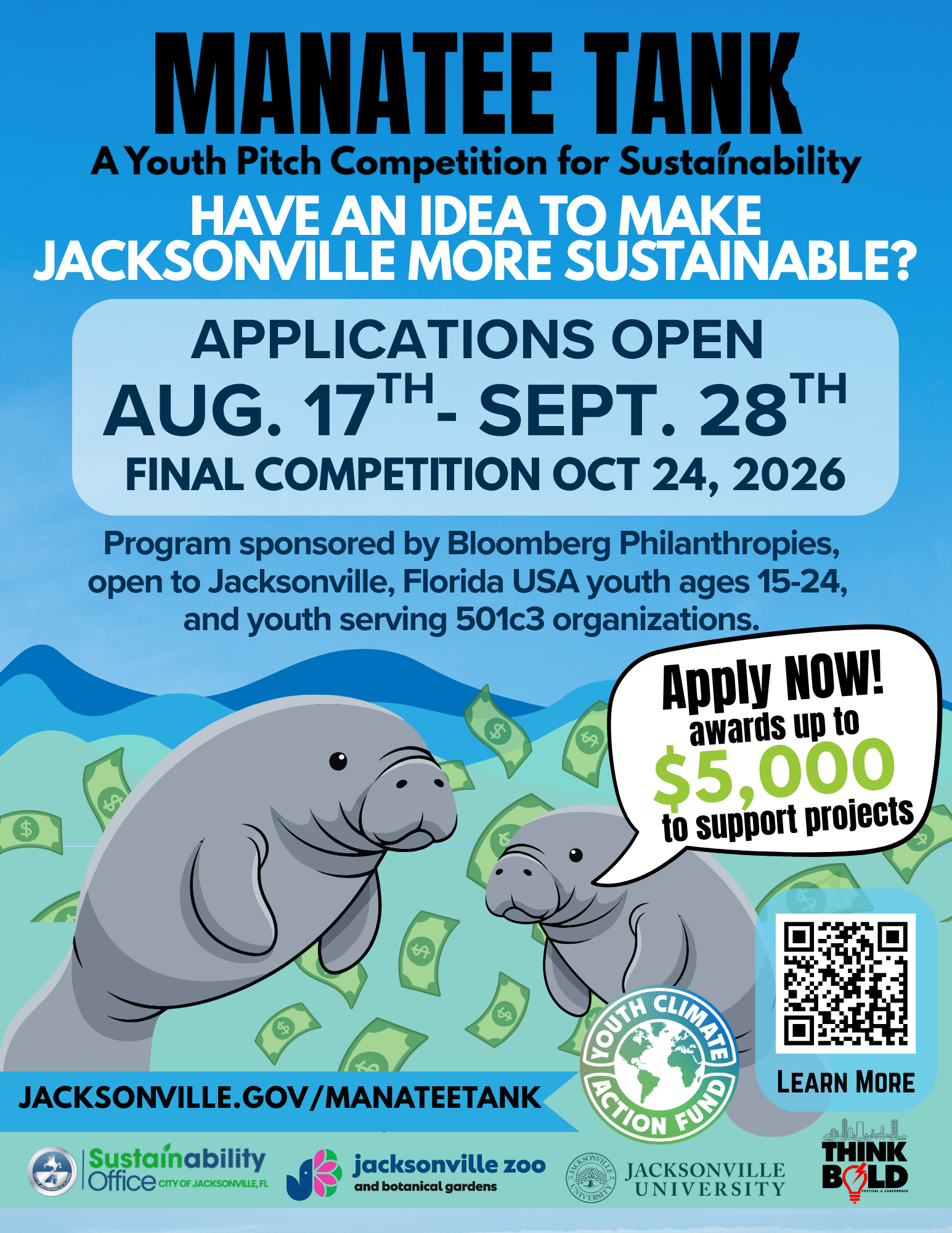
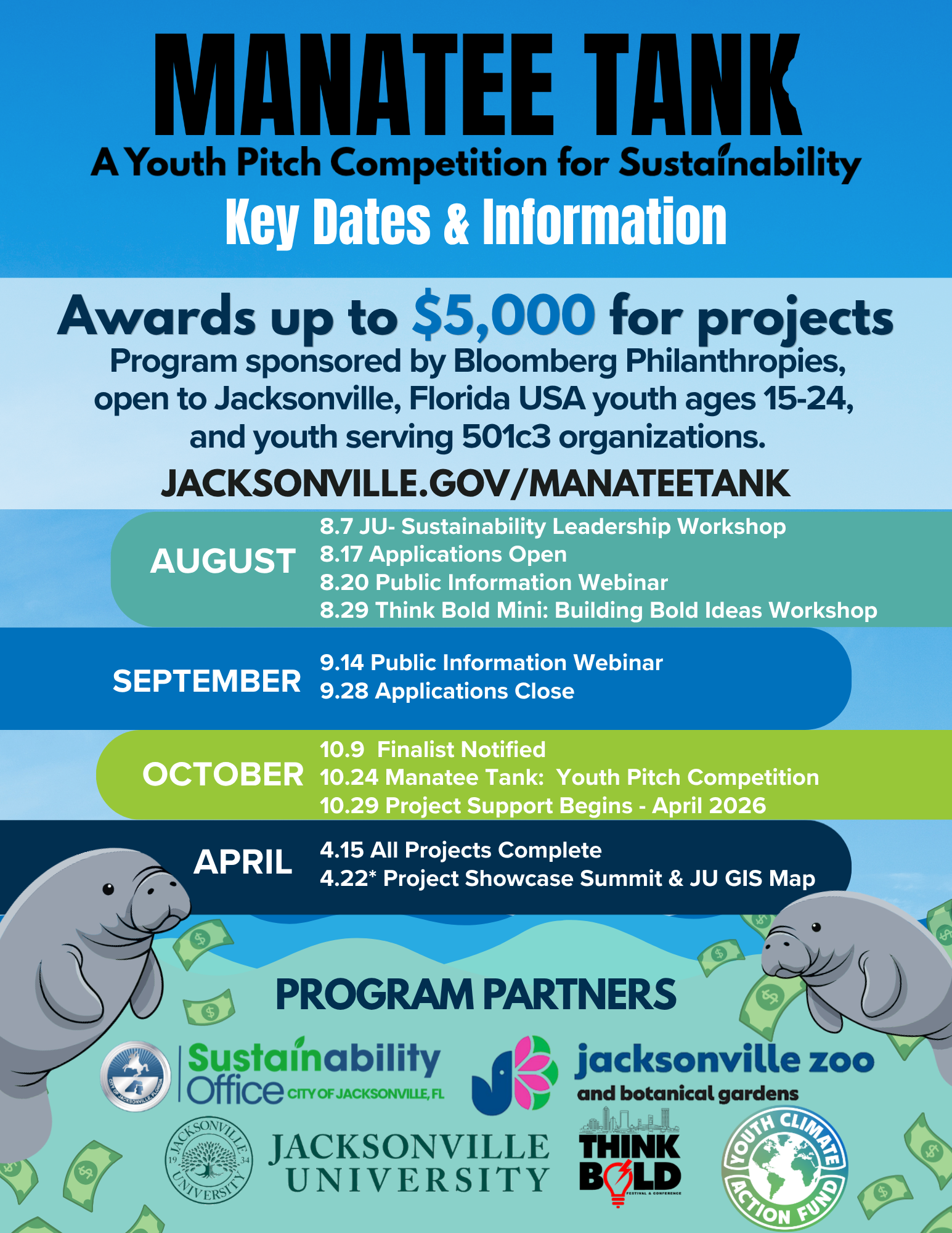
Download Program Flyer
Download Project Proposal Rubric
Program Schedule
| Date | Event | Details |
|---|---|---|
| July 27 | City Hall Kick-Off | Mayor Donna Deegan and the City of Jacksonville Office of Sustainability will share more about the program, joined by community partners including Jacksonville University, Think Bold All Access, and the Jacksonville Zoo and Botanical Gardens. |
| August 7 | Youth Sustainability Leadership Workshop | An engaging experience by Jacksonville University that introduces youth participants to Jacksonville's environmental challenges and opportunities while helping them develop competitive project ideas. Space is limited, reserve your spot |
| August 17 | Applications Open | Apply Now HERE |
| August 20 | Public Information Webinar #1 | COJ Office of Sustainability will host a webinar at 5:30 PM to go over the Youth Climate Action Fund and pitch competition. Open to potential applicants and community partners. Register |
| August 29 | Building Bold Ideas: Youth Pitch Development Workshop | Think Bold All Access will host a workshop on innovative ideas and pitches. Sign up here. |
| September 14 | Public Information Webinar #2 | COJ Office of Sustainability will host a webinar at 5:30 PM to provide feedback and address final questions before applications close. Register |
| September 28 | Applications Close | Applications for project proposals will close. |
| October 9th | Finalists Notified | Selected finalists will receive email notification with next steps. |
| October 24 | Manatee Tank: A Youth Pitch Competition for Sustainability - LIVE EVENT! | Manatee Tank: A Youth Pitch Competition for Sustainability will be held at Jacksonville Zoo and Botanical Gardens on the International Day of Climate Action. The Manatee Tank finalists will compete live in an exciting pitch competition event judged by city leaders and subject matter experts. |
| October 24- April 15th | Project Support & Mentorship | COJ Office of Sustainability and community partners will be available to offer support and advice throughout the project implementation window. |
| April 15 | All Projects Completed | All projects must be completed. |
| April 22 | Evaluation Summit | Jacksonville University will host a Youth Sustainability Project Evaluation Summit. This will provide participants with an opportunity to present their projects, share successes and challenges, discuss lessons learned, and celebrate the collective impact of their work. |
Thank You to our Community Partners!


FAQ - Frequently Asked Questions
What is a microgrant project?
Microgrants are small grants (US$1,000–US$5,000) that support youth-led sustainability projects aligned with your city’s priorities. They are designed to surface new ideas from young people and enable them to take action in their communities.
A microgrant project must:
- be proposed, designed, and led by at least two young people aged 15–24
- align with the priorities outlined in the Resilient Jacksonville &/or CleanAir NE Florida Regional Plan
- be completed by Thursday, April 15, 2027
- operate within a budget of US$1,000–US$5,000 using eligible expenses
- focus on youth leadership and action; equipment and infrastructure costs should not exceed 50% of the project budget
Each project must include:
- at least one output (a direct deliverable, such as number of events held)
- at least one outcome (the result of those activities)
- a numerical target for both
An ‘output’ is a direct deliverable or measurable result of activities (like ‘number of clean-up events held'), and an ‘outcome’ is what happens because of those activities. Both need to have a numerical target.
| Example Project (what happens in the project) | Example Output (what are the project activities) | Example Outcome (what happens as a result of those activities) |
|---|---|---|
| Organize a series of city park clean-ups | Number of youth-led clean-up events | Number of bags of trash picked up |
| Start a newsletter on city meetings related to sustainability | Number of youth registered for the newsletter | Number of youth attending public city government meetings |
| Create and distribute home rain garden kits at school | Number of rain garden kits distributed | Number of rain gardens planted |
| Start a collaboration to turn food waste into fertilizer pellets | Number of fertilizer pellets created | Number of pounds of food waste repurposed |
Who can participate?
Projects are led by young people, but funds must be disbursed to organizations. Eligible recipients include:
- Youth-led organizations (e.g. youth clubs or groups)
- Youth-serving organizations (adult-led organizations supporting young people)
- Sponsor organizations, such as city agencies, schools or other educational institutions, museums, or community organizations
Private companies, individuals or political parties or party-affiliated organizations are not eligible.
All organizations must:
- Be legally registered entities
- Be recognized as a non-profit or charitable organization under local laws (unless a public entity)
- Have a bank account in the organization’s name
What if I'm a youth without an organization?
Take initiative and reach out to organizations in your community that you feel could be a good fit with your project. If you are still unsure of who to contact, indicate you need an organizational match in your application. The City of Jacksonville Office of Sustainability is prepared to do some matchmaking.
What types of projects are eligible?
- Environmental education and awareness, like courses, experiences, or the arts
- Research and data collection, like mapping environmental health
- Resilience and adaptation, such as addressing water quality or heatwaves
- Green Infrastructure, reforestation, and environmental protection, like creating parks, or green roofs for community buildings
- Sustainable agriculture and food systems, like community gardens and workshops that would enrich community access to fresh food
- Promotion and advancement of circular economy, like sustainable fashion or rethinking the use of discarded materials
- Sustainable waste management, like sorting, collection, or cleaning
- Sustainable transportation, like encouraging walking, cycling, and using public transportation
- Climate governance, like youth councils or consultation of youth for public decision
Which project expenses are eligible for Youth Climate Action Fund microgrants?
Eligible microgrant project expenses:
- Project supplies and materials, including rental and purchase of items directly needed to carry out the project, such as equipment, tools, art supplies, or technology.
- Costs for organizing community events, workshops, or educational sessions, including venue rental, printing of materials for participants, and basic refreshments.
- Costs for any necessary permits to implement the project in accordance with local regulations.
- Reasonable ground travel expenses (such as public transit, ride shares, or taxis) for youth participants or team members directly involved in project implementation.
- Promotional materials to raise awareness about the project, encourage engagement from stakeholders and the greater community, and share project results, including photography, editorial support, and videography.
- Reasonable fees for training and mentorship offered in workshops with youth participants.
- Administrative costs that local NGOs, civic groups, neighborhood clubs, schools, or other organizations may charge for administering a microgrant on behalf of youth project leads. The costs should be no more than 15% of the microgrant value.
- Small amounts to enable youth participation such as per diems for food or gift cards if these expenses are reasonable in proportion to the activities. In no event may these expenses make up the majority of the microgrant.
- Capital investments when they do not exceed 50% of the microgrant and are an essential part of the project suggested and led by youth
Ineligible microgrant project expenses:
- Services/expenses covered by existing city initiatives
- Rent or utilities, unless specified above
- Nonprofit/NGO incorporation fees
- Speaker honorariums and speaker fees
- Scholarships
- Direct support to individuals or families
- Partisan political contributions or expenses 18
- Expenses related to political campaigns, fundraisers, or projects
- Expenses related to lobbying (attempting to influence legislation) or voter registration
- Expenses related to commercial activities
- Capital campaigns, endowments, or endowed chairs
- Payments to government officials
- Events or fundraisers not related to youth climate action
- Regranting or sub-granting to other organizations or individuals
Expense Eligibility Examples
| Project Description | Eligibility | Reason |
|---|---|---|
| Gift cards to a local grocery store to thank youth leads for their volunteer efforts and time commitment. | Eligible | Funds to enable youth participation should be reasonable, based on the activities, and cannot exceed 50% of the microgrant. |
| Paying a local environmental scientist a fee to lead a hands-on soil testing workshop with youth participants over three sessions. | Eligible | Reasonable fees for training and mentorship in a workshop setting with active youth participation are covered. |
| Paying a fee to a keynote speaker to give a presentation at a youth climate event. | Not Eligible | Speaker honorariums and one-time speaking fees are not covered, even for sustainability-related events. |
| Producing and distributing pamphlets to support the election of a local political candidate. | Not Eligible | Funds cannot be spent to support political campaigns or partisan political organizations. |
| Installment of solar panels for municipal buildings, like schools. | Not Eligible | Funds should be used for youth-led activities and no more than 50% of the microgrant should be directed to capital investments. |
Email tbess@coj.net with program questions